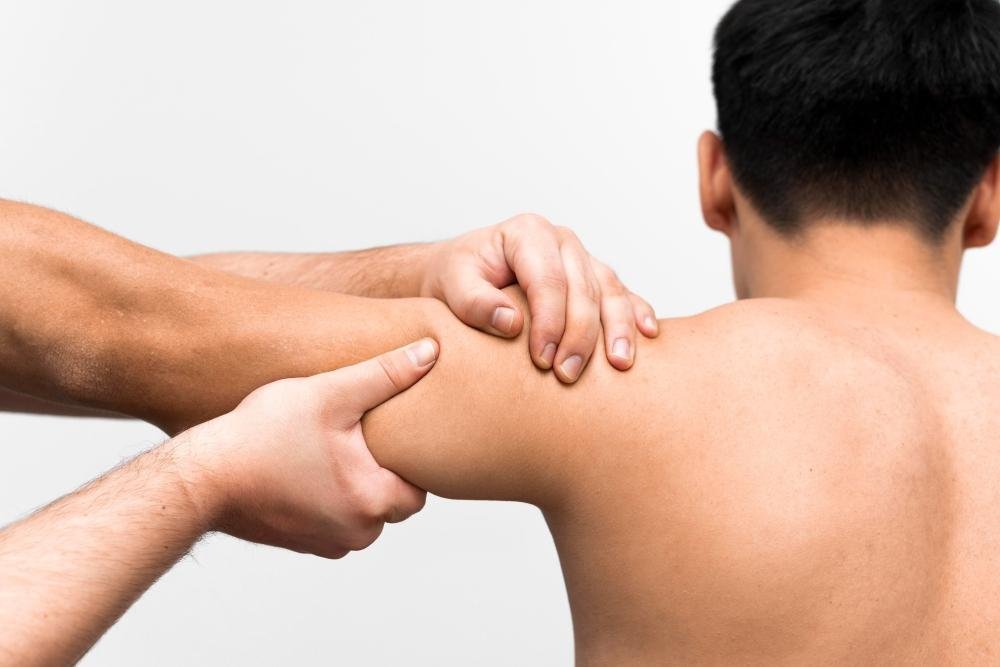
The shoulder has been grumbling for a few weeks. Some sessions it barely registers. Other times it makes itself known on the first few reps and then settles, or does not settle at all. If a competition is six weeks out, the choice between stopping and pushing through does not feel clean. Stopping feels like an overreaction to something that might resolve on its own. Pushing through feels like a gamble on tissue that is already sending signals.
Rotator cuff-related shoulder pain, or RCRSP, is among the more common shoulder presentations seen in overhead athletes, racquet sport players, swimmers, and gym-based lifters in Singapore. They are also among the more poorly understood. Train through or step back is not a binary decision. It is a question of what the tissue is currently tolerating and where load sits relative to that threshold.
What a Rotator Cuff Injury is and What It Feels Like
The rotator cuff is made up of four muscles and their tendons that help stabilise the shoulder and control movement, particularly during overhead activity. Rotator cuff-related shoulder pain describes a spectrum of conditions, including tendon overload, tendinopathy and, in some cases, partial or full-thickness tendon tears.
Symptoms vary depending on the structures involved, the severity of the condition, and how long it has been present. Common presentations include:
- Pain with overhead activity or lifting
- Pain when reaching behind your back or across your body
- Weakness during lifting or rotational movements of the shoulder, though the pattern differs across injuries
- In more significant injuries, pain at rest or disrupted sleep on the affected side
The connection between shoulder dislocation and rotator cuff tears is worth flagging. A proportion of shoulder dislocations, particularly in adults over 40, result in concurrent tendon damage. The dislocation event can be significant enough that the underlying rotator cuff involvement goes unexamined. Assessment after any meaningful dislocation is important, not optional.
Rotator Cuff Problems Exist on a Spectrum
Not every rotator cuff problem involves a tear. Some athletes develop rotator cuff tendinopathy, where the tendon is irritated and painful but structurally intact. Others have partial-thickness tears, where some fibres are disrupted but the tendon remains continuous. Full-thickness tears involve a complete break through the tendon. These conditions can present differently and may require different rehabilitation approaches.
Imaging findings and symptoms do not always correspond neatly. Age-related tendon changes are common, particularly after the age of 50, and many people with partial or even full-thickness tears have no pain at all. Likewise, some athletes with significant structural changes on MRI carry minimal functional impairment and train through it without knowing. Others with largely intact tissue on imaging have severe pain and meaningful strength loss. The scan tells you something about the structure’s appearance. It does not tell you how the shoulder is functioning under the loads that training actually places on it.
The more clinically useful question is not what the imaging shows in isolation. It is how the shoulder is responding to load, and what that response tells you about where the tissue currently sits.
Reading the Signals: Train Through or Step Back
Two sets of signals point in different directions, and it is worth knowing which you are dealing with.
Load modification is workable when:
- Pain settles within 24 hours of a session and is not progressively worsening across weeks.
- Strength during lifting and rotational movements remains largely intact.
- Discomfort remains at a tolerable level during training, often around 3 to 5 out of 10 or less, without altering how you move through overhead patterns.
Under these conditions, continuing to train with adjusted volume, reduced intensity, and exercise selection calibrated to what the tissue can currently absorb is a reasonable position.
Stepping back is the right call when:
- Pain is present at rest or disrupts sleep on the affected side.
- There is a sudden or progressive loss of strength, particularly when raising the arm.
- Symptoms are not improving despite meaningful reductions in training load.
These presentations warrant clinical assessment. Imaging may be appropriate where a significant tear is suspected, following trauma, or when symptoms fail to improve despite appropriate rehabilitation.
The distinction matters. Continuing to load tissue that is not tolerating it does not build capacity. It is one of the common pitfalls in sports injury rehab that quietly extends recovery timelines.

Why the Shoulder Rarely Works Alone
For overhead athletes, shoulder symptoms are not always caused by the shoulder alone. The rotator cuff operates within a kinetic chain that runs from the lower body through the trunk and into the shoulder and arm. Deficits in trunk strength, thoracic mobility, scapular control, or lower-body force production can concentrate load at the rotator cuff during repetitive overhead activity in ways the tissue was not designed to absorb across a full training block.
An athlete with limited thoracic rotation compensates by placing greater demands on the shoulder itself. One with poor scapular control under load places the rotator cuff in positions where it has less mechanical advantage and greater strain. Rehabilitation that addresses the shoulder in isolation, without examining what is contributing from further down the chain, often produces partial and temporary results.
Identifying those upstream and downstream contributors is as important as managing the local tissue.
Rotator Cuff Rehabilitation and Assessment at the Physio Circle
Early rehabilitation for rotator cuff-related shoulder pain focuses on restoring shoulder function while gradually rebuilding load tolerance, scapular control work, and eventually overhead loading. Rotator cuff rehabilitation progresses through this sequence as capacity builds. The progression is dictated by what the tissue can currently absorb, not by a fixed calendar. For athletes requiring surgical intervention before rehabilitation can progress, our post-surgery physical therapy programme provides structured rehabilitation from clearance through to return to sport.
A clinical assessment by a physio in Singapore examines strength, movement control, load response, and kinetic chain contributions rather than relying solely on imaging findings. For overhead athletes, that means assessing how the shoulder performs under the sport’s specific demands. Where sports physiotherapy forms the foundation of the plan, the rehabilitation pathway is built around returning to training rather than simply resolving pain.
For athletes who need structured gym-based progression alongside their physiotherapy, our personal trainer for injury rehabilitation works in parallel with the clinical team to ensure the loading programme reflects the shoulder’s current status.
If the shoulder has been signalling something for more than a few weeks and the train-through or step-back call is not clear, a physio session will give you a clearer picture than another week of testing it in training. The team can walk you through what the assessment covers, what the shoulder is currently capable of, and what the next stage of work should focus on.
*This post covers general information about rotator cuff injuries and rehabilitation principles. For advice specific to your injury, training history, and rehabilitation stage, consult your physiotherapist.